

Where the Thread Catches (weaving begins)

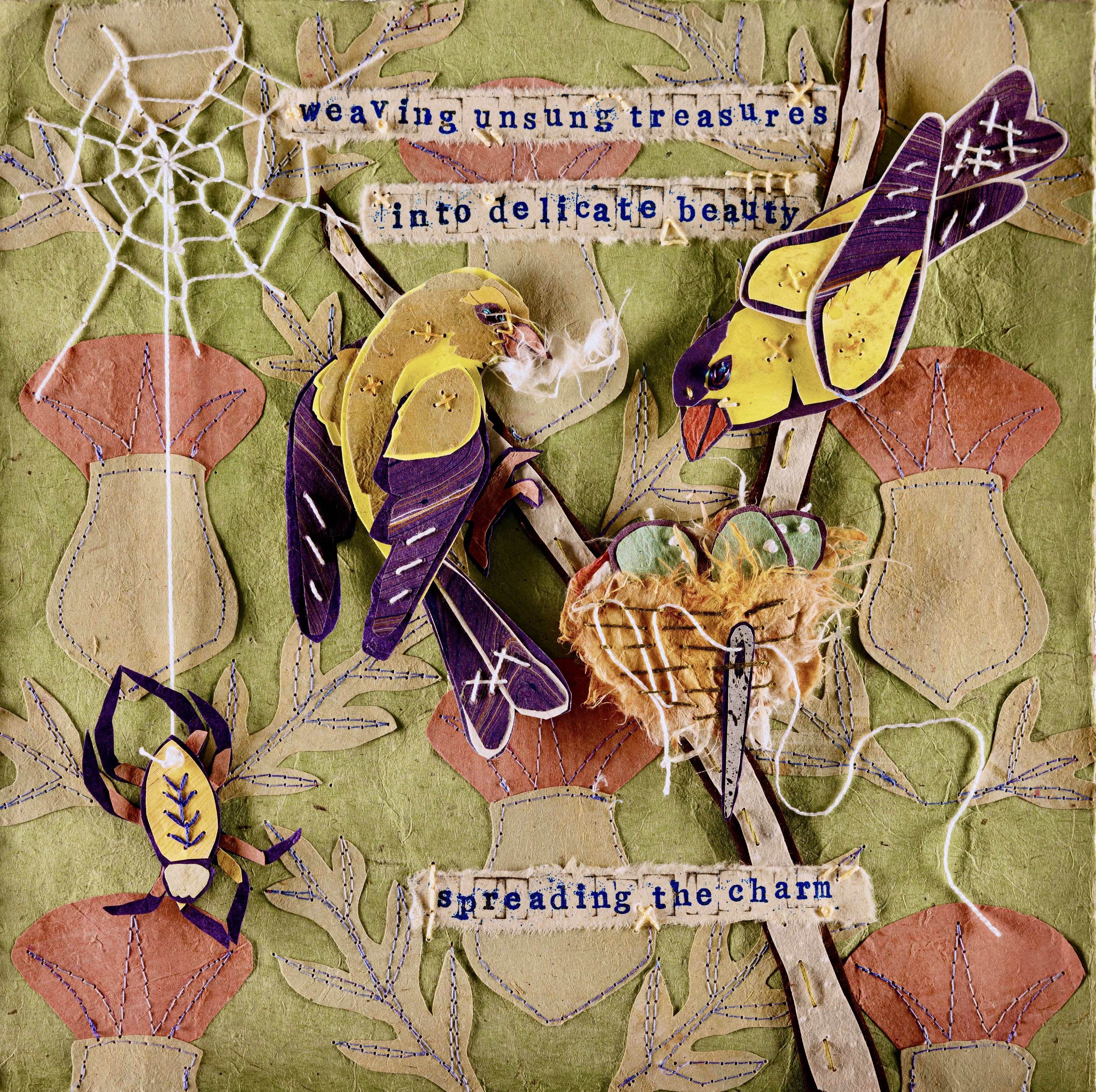
Everything is connected, but not always linearly. We are told that good stories have a beginning, a middle, and an end, that life shoots forward in a straight and purposeful line. As a child, I believed this. I would choose what to be—ballerina, concert pianist, veterinarian—and then follow that arrow cleanly to its mark. But this has not been the case. Now, from later side of my sixties, I can just begin to make out the patterns of my life. They are not fixed, but flickering and alive, like those old train station boards in period films. For a moment there is only clatter and confusion, a tumble of letters and numbers, and then, briefly, a destination appears.
Whenever I try to force the journey into coherence, my mind resists. It balks, refuses the imposition. So instead, I have become a weaver. I gather what arrives: image, memory, dream, sensation. And then I hold them together long enough for something to begin to take shape. Not a straight line, but a field. Not a plan, but a pattern.
This was not always encouraged. In high school, I once turned in a descriptive paragraph that I had labored over with great seriousness. Dictionary and thesaurus open beside me, I adorned each sentence with what I believed to be worthy language, think obscure, elaborate, and impressive vocabulary. An ornate tapestry of words. I was proud. My teacher, however, read it aloud as an example of everything writing should not be. Overwrought. Breathless. Silly. I still remember the feeling of being exposed, of having my earnestness turned inside out. That early humiliation stopped me in my tracks. For decades, I wrote only recipes. Letters. School research papers. Professors complimented me on my spare, no nonsense writing.
Suddenly something in me began to insist on something deeper. More mysterious. And more real.
It insisted when I walked in the woods and the alders leaned toward me, their bark marked with wild script, whispering. It insisted when goddesses began to arrive in my dreams and demanded remembrance. It insisted even as I wrestled with my own sensitivities, with the tides of emotions that made me feel both permeable and unmoored. I know now that this porousness is not a flaw but a condition of listening. Still, it brings its own questions. In memoir circles, we speak carefully about whose story is ours to tell. For someone who feels threaded into everything, that discernment can be difficult.
And yet, the desire remains: to invent a language and then translate it back to you. To learn the grammars of the more-than-human world—mineral and microbial, avian and animal, ancestral and stellar. The world is not simple, and I no longer wish to make it so. I am stunned by its intricacy. At times, that wonder opens me; at others, it overwhelms me into stillness.
It is here that she arrived: Akhilandeshwari, the Goddess Never Not Broken. She rides her crocodile through the currents of becoming, both shattering and crystallizing at once. She does not resolve the tension—she embodies it. Like the whirling dervish, she reveals a universe that is always in motion, always in the act of making and unmaking. There is no fixed form to cling to, only participation. In the dance of the world.
So I close my eyes and spin.
Matching my inner velocity to the turning of my body, I find, if only for a moment, a still point within the motion. When I open my eyes again, the world has shifted. Droplets caught in spider silk glimmer between blackberry canes.
Spider calls my name.
I bend toward her, listening. She sees me—not as fragmented, not as too much or too scattered—but whole in my multiplicity. Held in her many-faceted gaze, I feel, for a moment, whole and totally myself.
“Here,” she says, “is today’s weaving. Not a template. Not a rule. Just this way, today’s sacred path. There is truth in the ways of chance, chance removes overthinking, my love, and I not only honor it, I live by it.”
She works without certainty, but not without wisdom. With silk and spit, she casts a tiny balloon out into the unknown, willy nilly, just like that.
“What happens if the air is so still even dandelion seeds fall like pebbles straight to the ground,” I worry,
“What happens when the March winds roar like lions and threaten to sail your little bit of hopeful self across the sea and out of sight?”
“Toss it,” she answers. “Let it go.”
Every morning, while we slumber, she weaves a new web. When a thread catches, on anything at all, she nimbly steps out, no hesitation, building, anchoring, strengthening. Some are silks are eaten, reabsorbed, returned to the body for reuse. What remains becomes the warp.
And here is where I begin to understand.
What do I keep? What do I release? What is mine to weave? Today?
With armfuls of chosen threads, she begins the slow, deliberate work of connection, moving from edge to center, from possibility to form. It is not efficient. It is not predictable. But it is faithful.
So I give it a try.
Breathing in that same mixture of fear and exhilaration, I fashion my own small offering and release it. It disappears beyond my sight. I wait. A thread catches. Tentatively, I follow.
That arrow I once longed for, so straight, so certain, begins to glow again, but not at all as I imagined in my youth. Not as a fixed path laid out before me, but as motion. A relationship with life. An orientation within the field of knowing. A dance.
A needle, not an arrow.
And unlike a compass needle, it does not point toward a single destination, but outward into the vast, unfinished field where everything is still becoming.
The weaving begins.
With renewed daily diligence, I weave the disparate themes of my life into delicate beauty, honoring unsung treasures, and spreading the charm.