

Ghost Plant-Day 14

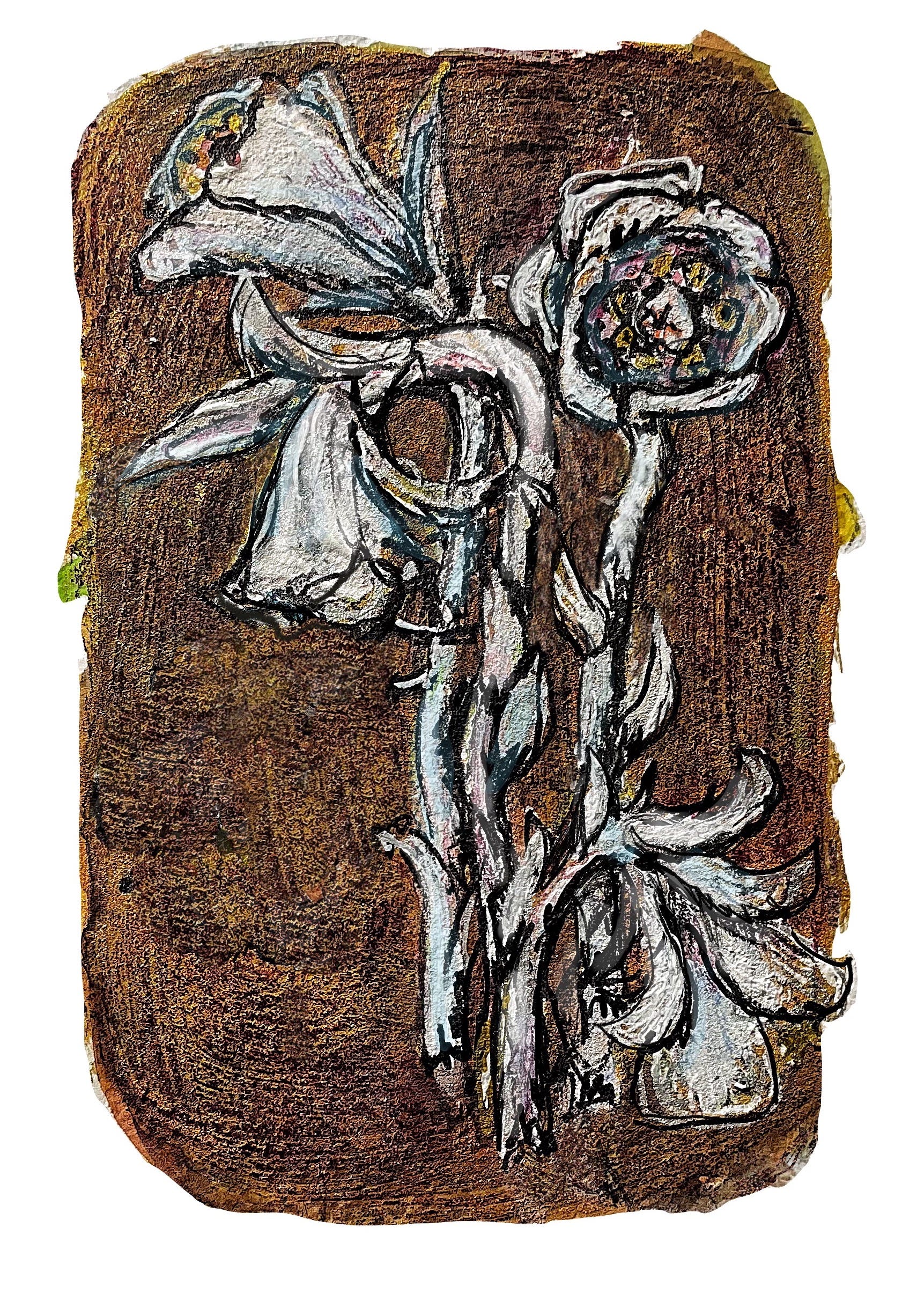
In a dream, I met the ghost plant, glowing as if she had swallowed the moon, translucent flowers towering larger than life under the bare branches of the beech tree. I stood stock still, holding my breath, taking in every detail, knowing the image to be essential for my ever searching soul.
Start by painting the plant, I told myself.
Once that was done, I began gathering stories and sifting what I read through the subconscious web of my deep imagination.
They do not photosynthesize and were labeled parasitic because all their nutrients come from a deep connection with the underground fungal network that can links entire forests into one large organism. Because it does not photosynthesize and gleams pale as moonlight on the forest floor, it seemed not quite plant enough to be a plant. Merlin Sheldrake says they are plants pretending not to be plants.
They emerge only in rich and deeply healthy forests. They were the favorite flower of the poet Emily Dickinson; she called them Indian Pipes and claimed that they were the preferred flower of life. Her friend Mabel Todd sent her a painting of Indian Pipes to symbolize her poetry being hidden from the world. According to one modern herbalist, a tincture made from the flowers and stems can be used to treat unrelenting pain and severe anxiety attacks. In my dream they were as big as a bush, but they are actually quite small and usually sprout up after a hard rain desperately awaited by a thirsty forest.
Ice Plant, Peace Pipe, Corpse Plant, Ghost Pipe, Death Plant
We cannot imagine that a plant who receives the entirety of its nutrients by hooking into the fungal network is anything other than parasitic, opportunistic, or, perhaps, merely a savvy competitor who has learned how to game the system.
I, at least, want to try to imagine a different way of seeing this unusual flower.
I want to imagine that the Ghost Plant is the artistic expression of the forest, a gift of exuberant health, expressing gratitude for the gift of rain. Scientists are finding that all the member plants of a healthy forests are linked by an underground fungal mat. We can’t understand it all completely, nor do we agree on the reasons for its existence and purpose, but we have observed that the fungal mat sends nutrients and chemical messages across species and across acres. I want to imagine that this communal entity sends up the Ghost Plant in an exuberance of spirit.
Paying more attention to animals than plants contributes to humans’ plant blindness. Paying more attention to plants than fungi makes us fungus-blind. --Merlin Sheldrake in his book “Entangled Life”
I think my dream is asking me to stay awake to what is happening beneath the surface, to what is happening beyond our typical assumptions about how life works, and to remain curious about the healing potential and deep wisdom that resides just under the surface of our own rich imaginations.
Like the poet Emily Dickinson.
Emily Dickinson, amongst some circles, had a reputation for being reclusive. However, when I dig behind the clichés and the gossip and the way she has been cast as tragic and perhaps mad, I found a woman who was fiercely devoted to her craft, who wove the natural world into her poetry, and knew how to be socially selective and thus preserve her precious time for the making of art and meaning.
So intimate and passionate was her love of Nature, she seemed herself a part of the high March sky, the summer day and bird-call, wrote her friend and sister-in-law Susan Huntington Gilbert Dickinson
With
Emily Dickinson, I found the same thing I found beneath the forest floor: a richer network of relationships than I had been taught to see.
It seems fitting that Ghost Pipe was her favorite flower. Remember that Dickinson called them Indian Pipes. In one poem she writes:
'Tis whiter than an Indian Pipe –
'Tis dimmer than a Lace –
No stature has it, like a Fog
When you approach the place –
The poem feels less like a description than an encounter. She circles the flower the way one circles a mystery, trying to name what cannot quite be named. A spirit. An atmosphere. A presence felt more than understood.
Perhaps this is why the flower found its way into my dream.
Not because I needed to learn a botanical fact, but because Ghost Pipe belongs to that category of beings that refuse to stay inside our definitions. It stands at the edge of visibility, nourished by relationships we can barely perceive, emerging briefly from the forest floor before disappearing again.
Both the ghost plant and Emily Dickinson have been misunderstood. Both resist easy categories. Both ask us to look again.
A few years ago I undertook the 100 Day Project.
Each morning I would sit down with paper, paint, and a question:
Who wants to speak through me today?
As I devoted myself to this practice, I began to understand these small paintings as votive offerings to the living world — simple acts of devotion made with gouache, ink, and lustrous gold paint.
In the evenings I would sit with the day’s painting and write a short reflection about the life of that being, about the ways our lives intersect, or about what I was learning by paying attention.
I have returned to these pieces since, tending and enlarging them, listening for the deeper currents as they slowly gather into a book.
For the next while, I will be sharing these paintings and devotional reflections here on Fridays. Taken together, they form a quiet record of one hundred days spent listening closely to the living world.
I mostly see trees and nature landscapes in my dreams. Sometimes cactus because I grew up in Arizona. I think that's why this encounter was so memorable. It was such an unusual plant that I had to look it up.
stunning i felt like i could see your dream description so clearly