

Cougar-Day 48

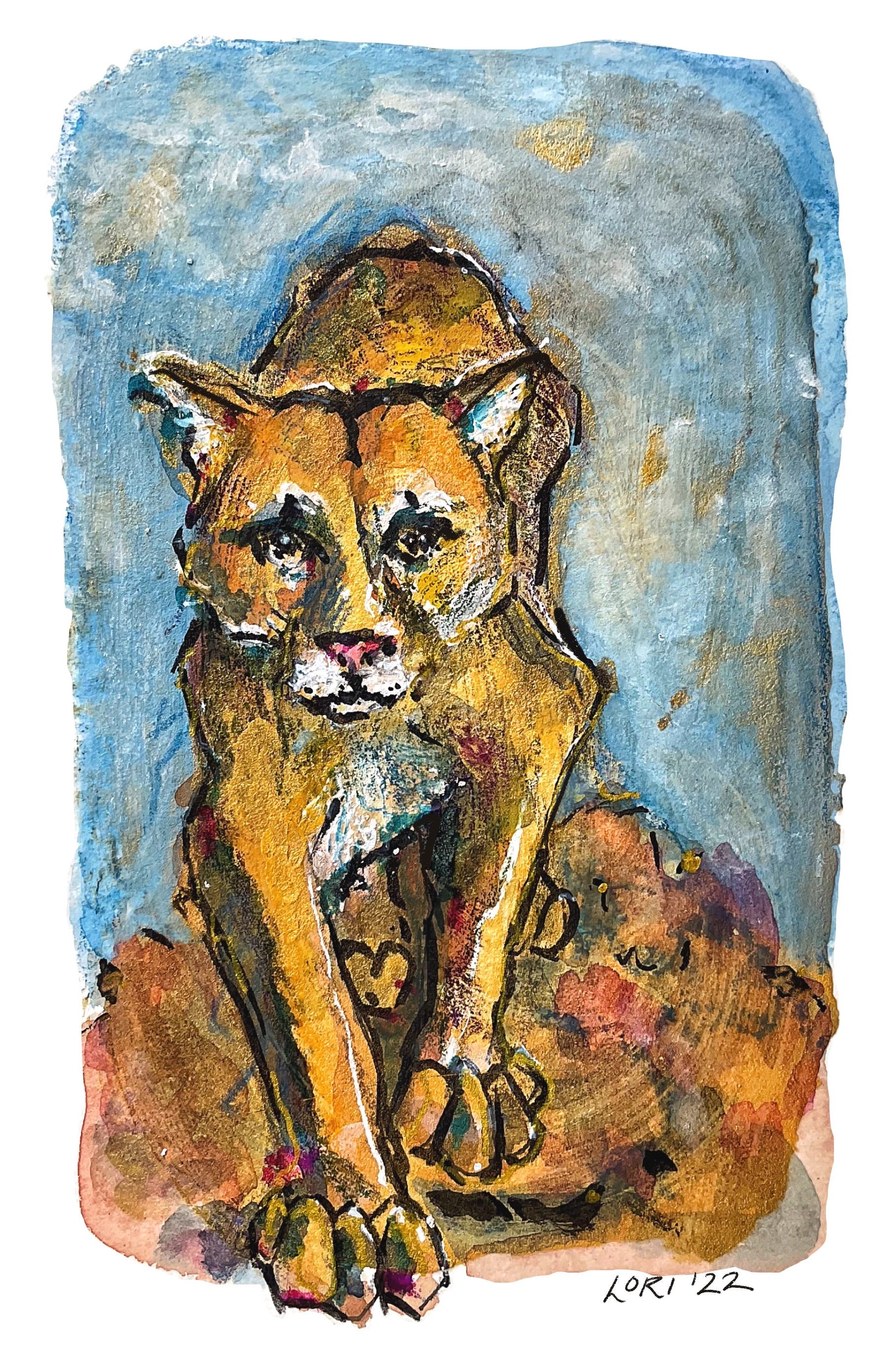
“We often wear so many opinions that wonder has very little chance of touching our skin,” says Mark Nepo.
She’s been stalking me.
I’ve felt her at the edges of my thinking, moving just beyond what I’m willing to see. And today, I turn to face her. Look her right in the eyes. Her steady, amber knowing eyes.
I can feel the forest of my opinions and questions rising up around me. Who am I? Who is she? Predator or prey? Danger or wonder? Threat or kin?
Changing how we look at something changes the world. Changes us. Margaret Wheatley writes, “As we work together to restore hope to our future, we need to include a new and strange ally—our willingness to be disturbed.”
The cougar does not ask for my comfort or even my attention. She asks for life.
Every time a mountain lion is shot for living too close to humans, I cry out. I grieve her. I grieve her prey. Our beloved pets. Our livestock. I grieve our fear, our longing for safety, our need to draw hard lines around what belongs.
And still, I want her to live.
A mouse has been camping out in my car. It would be super easy to set a trap. To eliminate that disturbance. To make the problem disappear.
But sitting with cougar, I feel the question shift.
Not: how do I eliminate what disturbs me?
But: how do I live with what disturbs me?
How do I make space for the cougar, for the mouse, and for the parts of myself that want control, certainty, safety at all costs?
We are a story-making species. I was raised to seek reason, to solve, to fix. But there are other ways of knowing, ways that I can learn from people who live closer to the webs of life and whose wisdoms and story-makings arise from relationship.
If I meet both cougar and mouse as beings I am in relationship with, how does that change me? How does it change the way I see the world?
The story does begin to shift. Not into something simple, but into something more alive.
So I practice.
I practice letting the disturbance remain long enough for wonder to enter.
I practice loosening my grip on the stories that keep me separate, the metaphors that oversimplify, the opinions that masquerade as truths.
I practice asking not who must go, but how might I might create space.
Where is the place where you are asked not to resolve the disturbance, but to stay?