

Cooper's Hawk-Day 17

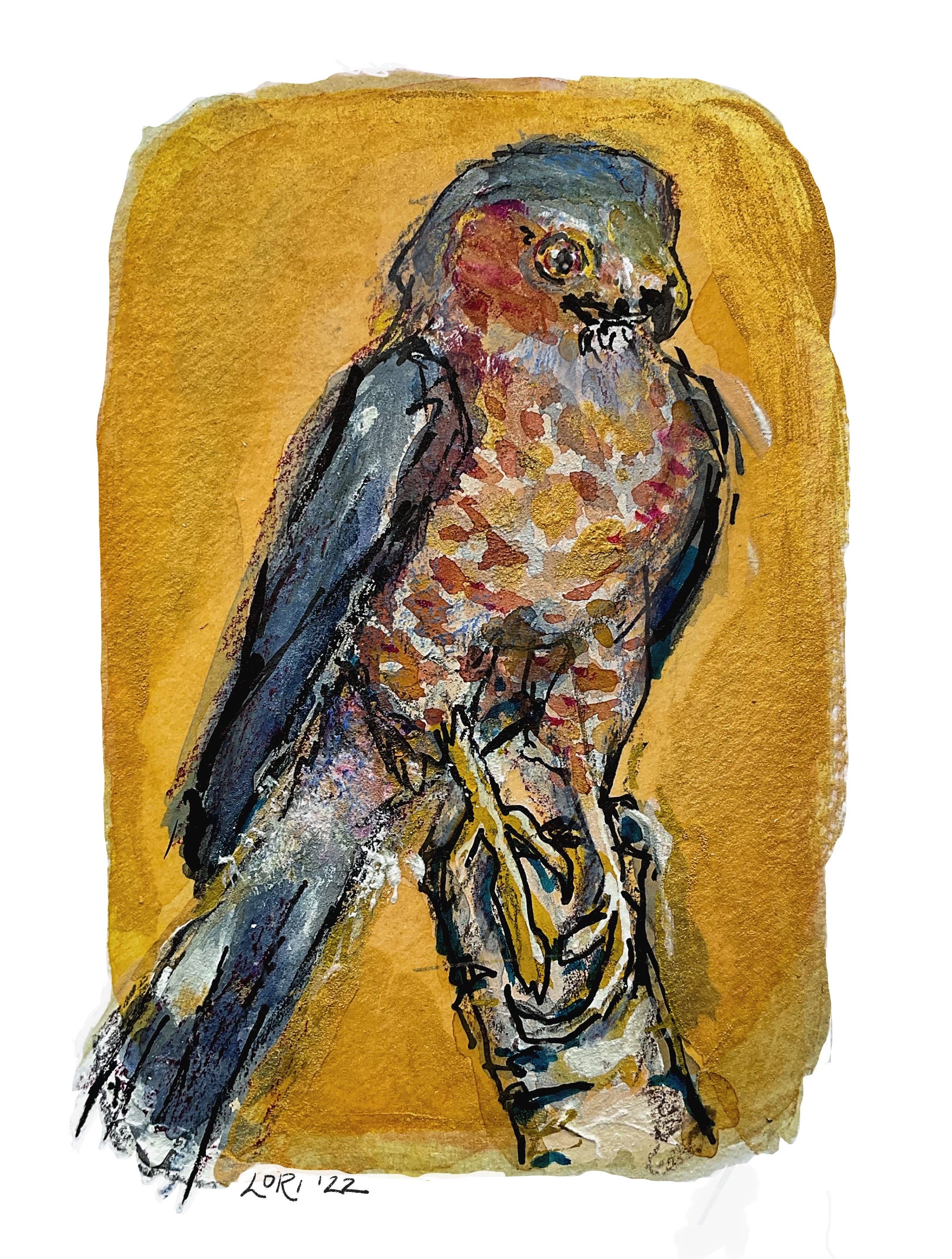
A few summers I was walking along the trail in our neighborhood woods back in Ohio when a hawk tumbled out of the sky, landing almost right at my feet. We stared at each other for several startled minutes, both of us panting with alarm. Gathering my wits, I began to wonder if she might require rescue, so I snapped a quick photo and sent it to the naturalist at the park.
He reassured me that birds of prey crash into things a lot. “They’re rather accident prone,” he said. Still, I worried. And waited. Watched.
Then, still holding my gaze, she gave her feathers a shake and soared away.
I was smitten. I saw her around the pond a few more times and I was always glad to see her. Since we had startled one another into an introduction. it seemed only polite to learn her name. She’s what we call a Cooper’s hawk. She’s also known as the big blue darter, chicken hawk, flying cross, hen hawk, quail hawk, striker, and swift hawk.
And, according to songbird lovers, the assassin of the bird kingdom.
Assassin.
Such a human word.
My new love is an assassin? Inwardly I moaned at my poor choice in friends.
I was ready to rescind all my admiration for this bird. But then I began thinking about the sort of meaning that we make about other non-human beings.
Owls are wise.
Sloths are lazy.
Foxes are sly.
Cooper’s Hawks are assassins.
Or so we say.
And I began to ponder about how easy it is to fall into judgement based on the words of other people. Do I need to believe that this beautiful being is an assassin just because the internet tells me so ? Can a hawk who hunts to feed herself and her family really be an assassin?
For me, this project is about honoring the wild. And that includes all of us. The Cooper’s hawk is an agile flyer, one of the best, it’s just that she hunts in forests and flies at high speeds through the trees.
She isn’t clumsy. She has given her life to a demanding sort of flight that has her tearing through branches, forging through uncertainty, in service of her hunger.
She belongs to this world as completely as the songbirds do and my task is not to decide whether she is hero or villain, but rather to meet her as herself.
An integral part of our shared world.
A few years ago I undertook the 100 Day Project.
Each morning I would sit down with paper, paint, and a question:
Who wants to speak through me today?
As I devoted myself to this practice, I began to understand these small paintings as votive offerings to the living world — simple acts of devotion made with gouache, ink, and lustrous gold paint.
In the evenings I would sit with the day’s painting and write a short reflection about the life of that being, about the ways our lives intersect, or about what I was learning by paying attention.
I have returned to these pieces since, tending and enlarging them, listening for the deeper currents as they slowly gather into a book.
For the next while, I will be sharing these paintings and devotional reflections here on Fridays. Taken together, they form a quiet record of one hundred days spent listening closely to the living world.